Sunday, November 13, 2011

Maidservants in the 18th Century..A Necessary Evil, According To Author Daniel DeFoe

Author Daniel Defoe Speaks Out Against The Excesses of Maidservants in the 18th century.

Women servants are now so scarce, that from thirty and forty shillings a year, their wages are increased of late to six, seven, nay, eight pounds per annum, and upwards; insomuch that an ordinary tradesman cannot well keep one; but his wife, who might be useful in his shop or business, must do the drudgery of household affairs; and all this because our servant-wenches are so puffed up with pride nowadays, that they never think they go fine enough: it is a hard matter to know the mistress from the maid by their dress; nay, very often the maid shall be much the finer of the two.
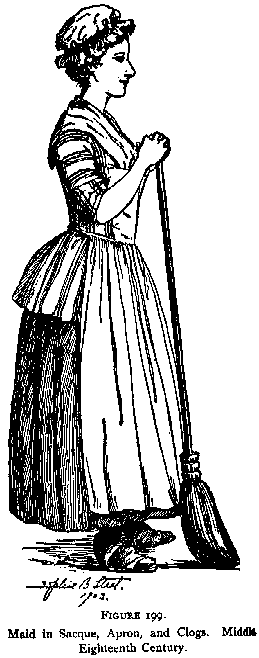
Our woolen manufacture suffers much by this, for nothing but silks and satins will go down with our kitchen-wenches; to support which intolerable pride, they have insensibly raised their wages to such a height as was never known in any age or nation but this.

Let us trace this from the beginning, and suppose a person has a servant-maid sent him out of the country, at fifty shillings, or three pounds a year. The girl has scarce been a week, nay, a day in her service, but a committee of servant-wenches are appointed to examine her, who advise her to raise her wages, or give warning; to encourage her to which, the herb-woman, or chandler-woman, or some other old intelligencer, provides her a place of four or five pounds a year; this sets madam cock-a-hoop, and she thinks of nothing now but vails and high wages, and so gives warning from place to place, till she has got her wages up to the tip-top.

Her neat's leathern shoes are now transformed into laced ones with high
heels; her yarn stockings are turned into fine woollen ones, with silk
clocks; and her high wooden pattens are kicked away for leathern clogs;
she must have a hoop too, as well as her mistress; and her poor scanty
linsey-woolsey petticoat is changed into a good silk one, for four or
five yards wide at the least. Not to carry the description farther, in
short, plain country Joan is now turned into a fine London madam, can
drink tea, take snuff, and carry herself as high as the best.

If she be tolerably handsome, and has any share of cunning, the
apprentice or her master's son is enticed away and ruined by her. Thus
many good families are impoverished and disgraced by these pert sluts,
who, taking the advantage of a young man's simplicity and unruly desires,
draw many heedless youths, nay, some of good estates, into their snares;
and of this we have but too many instances.

Some more artful shall conceal their condition, and palm themselves off
on young fellows for gentlewomen and great fortunes. How many families
have been ruined by these ladies? when the father or master of the
family, preferring the flirting airs of a young prinked up strumpet, to
the artless sincerity of a plain, grave, and good wife, has given his
desires aloose, and destroyed soul, body, family, and estate. But they
are very favourable if they wheedle nobody into matrimony, but only make
a present of a small live creature, no bigger than a bastard, to some of
the family, no matter who gets it; when a child is born it must be kept.

Our sessions' papers of late are crowded with instances of servant-maids
robbing their places, this can be only attributed to their devilish
pride; for their whole inquiry nowadays is, how little they shall do, how
much they shall have.

But all this while they make so little reserve, that if they fall sick
the parish must keep them, if they are out of place, they must prostitute
their bodies, or starve; so that from clopping and changing, they
generally proceed to whoring and thieving, and this is the reason why our
streets swarm with strumpets.

Thus many of them rove from place to place, from bawdy-house to service,
and from service to bawdy-house again, ever unsettled and never easy,
nothing being more common than to find these creatures one week in a good
family, and the next in a brothel. This amphibious life makes them fit
for neither, for if the bawd uses them ill, away they trip to service,
and if the mistress gives them a wry word, whip they are at a bawdy-house
again, so that in effect they neither make good whores nor good servants.


Those who are not thus slippery in the tail, are light of finger; and of
these the most pernicious are those who beggar you inchmeal. If a maid is a downright thief she strips you, it once, and you know your loss; but these retail pilferers waste you insensibly, and though you hardly miss it, yet your substance shall decay to such a degree, that you must have a very good bottom indeed not to feel the ill effects of such moths in your family.

Tea, sugar, wine, &c., or any such trifling commodities, are reckoned no thefts, if they do not directly take your pewter from your shelf, or your linen from your drawers, they are very honest: What harm is there, say they, in cribbing a little matter for a junket, a merry bout or so? Nay, there are those that when they are sent to market for one joint of meat, shall take up two on their master's account, and leave one by the way, for some of these maids are mighty charitable, and can make a shift to maintain a small family with what they can purloin from their masters and mistresses.

If you send them with ready money, they turn factors, and take threepence
or fourpence in the shilling brokerage. And here let me take notice of
one very heinous abuse, not to say petty felony, which is practised in
most of the great families about town, which is, when the tradesman gives
the house-keeper or other commanding servant a penny or twopence in the
shilling, or so much in the pound, for everything they send in, and
which, from thence, is called poundage.

This, in my opinion, is the greatest of villanies, and ought to incur
some punishment, yet nothing is more common, and our topping tradesmen,
who seem otherwise to stand mightily on their credit, make this but a
matter of course and custom. If I do not, says one, another will (for
the servant is sure to pick a hole in the person's coat who shall not pay
contribution). Thus this wicked practice is carried on and winked at,
while receiving of stolen goods, and confederating with felons, which is
not a jot worse, is so openly cried out against, and severely punished,
witness Jonathan Wild.

And yet if a master or mistress inquire after anything missing, they must
be sure to place their words in due form, or madam huffs and flings about
at a strange rate, What, would you make a thief of her? Who would live
with such mistrustful folks? Thus you are obliged to hold your tongue,
and sit down quietly by your loss, for fear of offending your maid,
forsooth!

Again, if your maid shall maintain one, two, or more persons from your
table, whether they are her poor relations, countryfolk, servants out of
place, shoe-cleaners, charwomen, porters, or any other of her menial
servants, who do her ladyship's drudgery and go of her errands, you must
not complain at your expense, or ask what has become of such a thing, or
such a thing; although it might never so reasonably be supposed that it
was altogether impossible to have so much expended in your family; but
hold your tongue for peace sake, or madam will say, You grudge her
victuals; and expose you to the last degree all over the neighbourhood.

Thus have they a salve for every sore, cheat you to your face, and insult
you into the bargain; nor can you help yourself without exposing
yourself, or putting yourself into a passion.

Another great abuse crept in among us, is the giving of veils to servants; this was intended originally as an encouragement to such as
were willing and handy, but by custom and corruption it is now grown to be a thorn in our sides, and, like other good things, abused, does more harm than good; for now they make it a perquisite, a material part of their wages, nor must their master give a supper, but the maid expects
the guests should pay for it, nay, sometimes through the nose. Thus have they spirited people up to this unnecessary and burthensome piece of
generosity unknown to our forefathers, who only gave gifts to servants at Christmas-tide, which custom is yet kept into the bargain; insomuch that a maid shall have eight pounds per annum in a gentleman's or merchant's family. And if her master is a man of free spirit, who receives much
company, she very often doubles her wages by her veils; thus having meat, drink, washing, and lodging for her labour, she throws her whole income upon her back, and by this means looks more like the mistress of the family than the servant-wench.

And now we have mentioned washing, I would ask some good housewifely
gentlewoman, if servant-maids wearing printed linens, cottons, and other
things of that nature, which require frequent washing, do not, by
enhancing the article of soap, add more to housekeeping than the
generality of people would imagine? And yet these wretches cry out
against great washes, when their own unnecessary dabs are very often the
occasion.

But the greatest abuse of all is, that these creatures are become their
own lawgivers; nay, I think they are ours too, though nobody would
imagine that such a set of slatterns should bamboozle a whole nation; but
it is neither better nor worse, they hire themselves to you by their own
rule.

That is, a month's wages, or a month's warning; if they don't like you
they will go away the next day, help yourself how you can; if you don't
like them, you must give them a month's wages to get rid of them.

This custom of warning, as practised by our maid-servants, is now become
a great inconvenience to masters and mistresses. You must carry your
dish very upright, or miss, forsooth, gives you warning, and you are
either left destitute, or to seek for a servant; so that, generally
speaking, you are seldom or never fixed, but always at the mercy of every
new comer to divulge your family affairs, to inspect your private life,
and treasure up the sayings of yourself and friends. A very great
confinement, and much complained of in most families.

Thus have these wenches, by their continual plotting and cabals, united
themselves into a formidable body, and got the whip hand of their
betters; they make their own terms with us; and two servants now, will
scarce undertake the work which one might perform with ease;
notwithstanding which, they have raised their wages to a most exorbitant
pitch; and, I doubt not, if there be not a stop put to their career, but
they will bring wages up to 201. per annum in time, for they are much
about half way already.

It is by these means they run away with a great part of our money, which
might be better employed in trade, and what is worse, by their insolent
behaviour, their pride in dress, and their exorbitant wages, they give
birth to the following inconveniences.

First, They set an ill example to our children, our apprentices, our
covenant servants, and other dependants, by their saucy and insolent
behaviour, their pert, and sometimes abusive answers, their daring
defiance of correction, and many other insolences which youth are but too
apt to imitate.

Secondly, By their extravagance in dress, they put our wives and
daughters upon yet greater excesses, because they will, as indeed they
ought, go finer than the maid; thus the maid striving to outdo the
mistress, the tradesman's wife to outdo the gentleman's wife, the
gentleman's wife emulating the lady, and the ladies one another; it seems
as if the whole business of the female sex were nothing but an excess of
pride, and extravagance in dress.

Thirdly, The great height to which women-servants have brought their wages, makes a mutiny among the men-servants, and puts them upon raising their wages too; so that in a little time our servants will become our partners; nay, probably, run away with the better part of our profits, and make servants of us vice versa. But yet with all these inconveniences, we cannot possibly do without these creatures; let us
therefore cease to talk of the abuses arising from them, and begin to think of redressing them. I do not set up for a lawgiver, and therefore shall lay down no certain rules, humbly submitting in all things to the wisdom of our legislature. What I offer shall be under correction; and upon conjecture, my utmost ambition being but to give some hints to remedy this growing evil, and leave the prosecution to abler hands.

 Compiled From Sources In The Public Domain.


Smiles & Good Reading,
Teresa
************************************
It is not wealth one asks for, but just enough to preserve one’s dignity, to work unhampered, to be generous, frank and independent.
W. Somerset Maugham (1874-1965) Of Human Bondage, 1915

Monday, November 7, 2011

MyLadyWeb Presents The November Giveaway Hop

Hello and Welcome! 


 The Old Fashioned Regency Romance
A Very Merry Chase

Now available...
in an easy to read oversize, large print paperback version.

  Is Happy To Participate In

The November Giveaway Hop

 
November 8 - 11, 2011

I am providing several gifts just to thank everyone for stopping by
plus the opportunity to win a personalized PDF copy of my 
sweet, old-fashioned Regency Romance Novel, 
A Very Merry Chase 
for one lucky commenter.

To Enter To Win A Very Merry Chase
Simply Leave A Comment Here

Try Using Google's Chrome Browser If Your Browser Will Not Work.
Or Leave Me A Comment On Facebook.

ALSO
For Additional Entries

Like Our Author Page On 
 
Facebook
Where You Can Click On Our Photo Gallery To Find
Eight Complimentary Musical Jigsaw Puzzles To Download As Gifts

And/Or
Like A Very Merry Chase on  
Amazon

There are also lots of free gifts available at 
LadySilk's Regency Romance Revival 
On Our Complimentary Bookshelf
So be sure to bookmark us so you can come back after the
November Giveaway Hop is Over!


Smiles & Good Fortune,
Teresa
************************************
It is not wealth one asks for, but just enough to preserve one’s dignity, to work unhampered, to be generous, frank and independent. W. Somerset Maugham (1874-1965) Of Human Bondage, 1915

Wednesday, November 2, 2011

Lucy Cleaver Female American Retail Worker Surviving In Poverty

Welcome to the world of Lucy Cleaver, a young American woman of twenty-five, who, in the early 20th century, entered one of the New York department stores at the age of twenty, at a salary of $4.50 a week.

In the course of the five years of her employment her salary had been raised one dollar. She stood for nine hours every day. If, in dull moments of trade, when no customers were near, she made use of the seats lawfully provided for employees, she was at once ordered by a floor-walker to do something that required standing.

During the week before Christmas, Lucy worked standing over fourteen hours every day, from eight to twelve-fifteen in the morning, one to six in the afternoon, and half past six in the evening till half past eleven at night. So painful to the feet becomes the act of standing for these long periods that some of the girls forego eating at noon in order to give themselves the temporary relief of a foot-bath. For this overtime the store gave her $20, presented to her, not as payment, but as a Christmas gift.

The management also allowed a week's vacation with pay in the summer-time and presented a gift of $10.

After five years in this position she had a disagreement with the floor-walker and was summarily dismissed.

She then spent over a month in futile searching for employment, and finally obtained a position as a stock girl in a Sixth Avenue suit store at $4 a week, a sum less than the wage for which she had begun work five years before. Within a few weeks, dullness of trade had caused her dismissal. She was again facing indefinite unemployment.

Her income for the year had been $281. She lived in a large, pleasant home for girls, where she paid only $2.50 a week for board and a room shared with her sister. Without the philanthropy of the home, she could not have made both ends meet. It was fifteen minutes' walk from the store, and by taking this walk twice a day she saved carfare and the price of luncheon. She did her own washing, and as she could not spend any further energy in sewing, she bought cheap ready-made clothes. This she found a great expense. Cheap waists wear out very rapidly. In the year she had bought 24 at 98 cents each. Here is her account, as nearly as she had kept it and recalled it for a year: a coat, $10; 4 hats, $17; 2 pairs of shoes, $5; 24 waists at 98 cents, $23.52; 2 skirts, $4.98; underwear, $2; board, $130; doctor, $2; total, $194.50. This leaves a balance of $86.50. This money had paid for necessaries not itemized,--stockings, heavy winter underwear, petticoats, carfare, vacation expenses, every little gift she had made, and all recreation.

She belonged to no benefit societies, and she had not been able to save money in any way, even with the assistance given by the home. So much for her financial income and outlay.

After giving practically all her time and force to her work, she had not received a return sufficient to conserve her health in the future, or even to support her in the present without the help of philanthropy. She was ill, anemic, nervous, and broken in health.

Before adding the next budget, two points in Lucy Cleaver's outlay should, perhaps, be emphasized in the interest of common sense. The first is the remarkable folly of purchasing 24 waists at 98 cents each. In an estimate of the cost of clothing, made by one of the working girls' clubs of St. George's, the girls agreed that comfort and a presentable appearance could be maintained, so far as expenditure for waists was concerned, on $8.50 a year. This amount allowed for five shirt-waists at $1.20 apiece, and one net waist at $2.50.

In extenuation of Lucy Cleaver's weak judgment as a waist purchaser, and the poor child's one absurd excess, it must, however, be said that the habit of buying many articles of poor quality, instead of fewer articles of better quality, is frequently a matter, not of choice, but of necessity. The cheap, hand-to-mouth buying which proves paradoxically so expensive in the end is no doubt often caused by the simple fact that the purchaser has not, at the time the purchase is made, any more money to offer. Whatever your wisdom, you cannot buy a waist for $1.20 if you possess at the moment only 98 cents. The St. George's girls made their accounts on a basis of an income of $8 a week. Lucy Cleaver never had an income of more than $5.50 a week, and sometimes had less. The fact that she spent nearly three times as much as they did on this one item of expenditure, and yet never could have "one net waist at $2.50" for festal occasions, is worthy of notice.

The other point that should be emphasized is the fact that she did her own washing. The more accurate statement would be that she did her own laundry, including the processes, not only of rubbing the clothes clean, but of boiling, starching, bluing, and ironing. This, after a day of standing in other employment, is a vital strain more severe than may perhaps be readily realized. Saleswomen and shop-girls have not the powerful wrists and muscular waists of accustomed washerwomen, and are in most instances no better fitted to perform laundry work than washerwomen would be to make sales and invoice stock. But custom requires exactly the same freshness in a saleswoman's shirt-waist, ties, and collars as in those of women of the largest income. The amount the girls of the St. George's Working Club found it absolutely necessary to spend in a year for laundering clothes was almost half as much as the amount spent for lodging and nearly two-thirds as much as the amount originally spent for clothing.

Where this large expense of laundry cannot be met financially by saleswomen, it has to be met by sheer personal strength. One department-store girl, who needed to be especially neat because her position was in the shirt-waist department, told us that sometimes, after a day's standing in the store, she worked over tubs and ironing-boards at home till twelve at night.

It is worth noting, as one cause of the numerous helpless shifts of the younger salesgirls, that, living, as most of them do, in a semi-dependence, on either relatives or charitable homes, it is almost impossible for them to learn any domestic economy, or the value of money for living purposes.


Compiled From Sources In The Public Domain.


Good Reading & Good Fortune,
Teresa
************************************
It is not wealth one asks for, but just enough to preserve one’s dignity, to work unhampered, to be generous, frank and independent. W. Somerset Maugham (1874-1965) Of Human Bondage, 1915

Tuesday, November 1, 2011

The Ballad of the Clever Maid Who Outwitted The Unscrupulous Outlandish Knight

The Clever Maid Who Outwitted The Unscrupulous Knight

This is the common English stall copy of a ballad of which there are a variety of versions, for an account of which, and of the presumed origin of the story, the reader is referred to the notes on the Water o’ Wearie’s Well, in the Scottish Traditional Versions of Ancient Ballads, published by the Percy Society. By the term ‘outlandish’ is signified an inhabitant of that portion of the border which was formerly known by the name of ‘the Debateable Land,’ a district which, though claimed by both England and Scotland, could not be said to belong to either country. The people on each side of the border applied the term ‘outlandish’ to the Debateable residents. The tune to The Outlandish Knight has never been printed; it is peculiar to the ballad, and, from its popularity, is well known.

An Outlandish knight came from the North lands,
And he came a wooing to me;
He told me he’d take me unto the North lands,
And there he would marry me.
‘Come, fetch me some of your father’s gold,
And some of your mother’s fee;
And two of the best nags out of the stable,
Where they stand thirty and three.’
She fetched him some of her father’s gold,
And some of the mother’s fee;
And two of the best nags out of the stable,
Where they stood thirty and three.
She mounted her on her milk-white steed,
He on the dapple grey;
They rode till they came unto the sea side,
Three hours before it was day.
‘Light off, light off thy milk-white steed,
And deliver it unto me;
Six pretty maids have I drowned here,
And thou the seventh shall be.
‘Pull off, pull off thy silken gown,
And deliver it unto me,
Methinks it looks too rich and too gay
To rot in the salt sea.
‘Pull off, pull of thy silken stays,
And deliver them unto me;
Methinks they are too fine and gay
To rot in the salt sea.
‘Pull off, pull off thy Holland smock,
And deliver it unto me;
Methinks it looks too rich and gay,
To rot in the salt sea.’
‘If I must pull off my Holland smock,
Pray turn thy back unto me,
For it is not fitting that such a ruffian
A naked woman should see.’
He turned his back towards her,
And viewed the leaves so green;
She catched him round the middle so small,
And tumbled him into the stream.
He dropped high, and he dropped low,
Until he came to the side, -
‘Catch hold of my hand, my pretty maiden,
And I will make you my bride.’
‘Lie there, lie there, you false-hearted man,
Lie there instead of me;
Six pretty maids have you drowned here,
And the seventh has drowned thee.’
She mounted on her milk-white steed,
And led the dapple grey,
She rode till she came to her own father’s hall,
Three hours before it was day.
The parrot being in the window so high,
Hearing the lady, did say,
‘I’m afraid that some ruffian has led you astray,
That you have tarried so long away.’
‘Don’t prittle nor prattle, my pretty parrot,
Nor tell no tales of me;
Thy cage shall be made of the glittering gold,
Although it is made of a tree.’
The king being in the chamber so high,
And hearing the parrot, did say,
‘What ails you, what ails you, my pretty parrot,
That you prattle so long before day?’
‘It’s no laughing matter,’ the parrot did say,
‘But so loudly I call unto thee;
For the cats have got into the window so high,
And I’m afraid they will have me.’
‘Well turned, well turned, my pretty parrot,
Well turned, well turned for me;
Thy cage shall be made of the glittering gold,
And the door of the best ivory.’
**************************
I have a graduate degree in history and I love history in all it’s forms–especially women’s history. A graduate degree in women’s studies was not an option at the university where I received my MA in History so I had to make do with a more generalized degree. However, in every class I made up for the lack by researching the condition of women in each age that I studied. I have always been fascinated by women’s history, so I thought I would start sharing some of the lost treasures that I uncover. I believe that most people have curious minds and like glimpses of how the world was, and how things were perceived in the past. I firmly believe in the idea that we must remember history in order to learn from it, grow and hopefully cut down on the number of stupid mistakes that random impulse and intellectual curiosity and greed and a thousand other human motivators lead us to make.

Smiles and Good Fortune,
Teresa Thomas Bohannon


****
It is not wealth one asks for, but just enough to preserve one’s dignity, to work unhampered, to be generous, frank and independent.
– W. Somerset Maugham (1874 - 1965) Of Human Bondage, 1915

Sunday, October 23, 2011

MyLadyWeb Presents The Spooktacular Giveaway Hop

Hello and Welcome! 


The Spooktacular Giveaway Hop Is Over

(Our Winner Was Holly Storm.)


But The Free


Thank You For Stopping By Gifts Are Still Available Below :)


A Very Merry Chase

Now available...
in an easy to read oversize, large print paperback version.

Was Happy to Participate In The 2011

Spooktacular Giveaway Hop

October 24 - 31, 2011

I am providing two gifts just to thank everyone for stopping by
plus the opportunity to win a personalized PDF copy of my 
sweet, old-fashioned Regency Romance Novel, 
A Very Merry Chase 
for one lucky commenter.


To Enter To Win A Very Merry Chase
Simply Leave A Comment Here

Try Using Google's Chrome Browser If Your Browser Will Not Work.
Or Leave Me A Comment On Facebook.

ALSO
For Additional Entries

Like Our Author Page On 
Facebook
Where You Can Click On Our Photo Gallery To Find
Eight Complimentary Musical Jigsaw Puzzles To Download As Gifts

And/Or
Like A Very Merry Chase on  
Amazon

And/Or

Follow Us On GFC or Networked Blogs...or Both :)
(I've just moved the blog here, so I'm starting all over again with GFC & Networked Blogs :) 

There are also lots of free gifts available at 
LadySilk's Regency Romance Revival 
On Our Complimentary Bookshelf
So be sure to bookmark us so you can come back after the
Autumn Harvest Fall Between The Pages Book Giveaway Hop is Over!
Smiles & Good Fortune,
Teresa
************************************
It is not wealth one asks for, but just enough to preserve one’s dignity, to work unhampered, to be generous, frank and independent. W. Somerset Maugham (1874-1965) Of Human Bondage, 1915

Saturday, October 15, 2011

Anna Patricio Author of the new historical novel ASENATH

Today I am happy to welcome historical novelist Anna Patricio author of ASENATH. To commemorate the occasion, I have prepared a complimentary musical jigsaw puzzle of her book cover for your enjoyment.  In addition, Anna will be awarding a Smashwords' certificate good for one complimentary copy of ASENATH, to one lucky commentator. 

A. I am Anna Patricio, a debut novelist of historical fiction. I have been an ancient history lover since my teens, and pursued formal studies in it at Macquarie University, Australia. I love Egypt, Israel, Greece and Rome; and I hope to learn more about the Ancient Near East in the future. I recently travelled to Lower Egypt (specifically Cairo and the Sinai), Israel and Jordan. I definitely plan to return to Egypt and see more of it in the future, as my time there was way too short.


Q. Tell us about your novel, ASENATH.

A. ASENATH is a fictional memoir of the little-known wife of Joseph of
the multicoloured coat fame. I have always been an enthusiast of the
Joseph story and recently, I realised that next to nothing is known
about the woman he married. All the Book of Genesis tells us about her
is that she was the daughter of a priest of On (more famously known as
Heliopolis). When I looked up Asenath, I found practically nothing
about her. My curiosity about her then paved the way for imagination.


Q. What was it about historical fiction that captured your fancy?

A. I suppose it is because first and foremost, I am an ancient history
lover. Secondly, when writing historical fiction, I get to explore a
world different from the one I live in. I have a bit of a wanderlust,
I guess, so I really appreciate this. If I wrote contemporary fiction,
I would be limited to the same old environment.
Not that there is anything wrong with contemporary settings - who
knows, I may try it sometime in the future. But for now, I have no
intention to leave historical fiction. Especially Egyptian fiction.


Q. Do you have an all-time favorite historical novel, and what
elements make it your favorite?

A. I love MEMOIRS OF A GEISHA by Arthur Golden. I love the depths of
passion and emotion conveyed in this novel, especially the heroine's
long-suffering love for her love interest. I like especially the
analogies Golden uses to convey complex emotions - this is a
remarkable feat. And this has been said many times before, but I will
say it again: it's hard to believe a man wrote this book!
I also like the novels of Wilbur Smith and Pauline Gedge who, in my
opinion, are the tops in Egyptian fiction. I love how they bring
Ancient Egypt to life, and I also like the way they develop their
characters. It's very believable, and something everyone can relate
to. Not to mention that these 2 authors have managed to "humanise" the
Ancient Egyptians - portray them as real people. Usually, they are
portrayed as larger than life.


Q. How do you research your novels?

A. Well, I have a degree in ancient history, so this has been made
tons easier, less overwhelming. Not to mention that I have already
read much about Joseph prior to writing my novel - I read midrash
stories, Jewish folktales, and even some episodes from the Koran.
So when the time came to research on ASENATH, I looked at my
notes/syllabi and also headed to the library of my alma mater.

On Writing:

Q. Is there anything you absolutely must have in order to write?

A. Absolute, cemetery-like silence. I can't write when there's a lot
of noise around. I tried writing with classical music, but even that
was distracting. So yes, I need total silence.


Q. What is the most difficult part of writing for you?

A. Overcoming writers' block, I guess. Sometimes, I want to write but
can't, for some reason. Eventually, it becomes clear that I won't be
able to write for the day.
But more difficult than that was searching for publication. At times,
I got really disheartened. But then, I landed a contract with Imajin
Books. It took me nearly a year, but it was worth it.


Q. What's a typical working day like for you? When and where do you write?

A. It's very spontaneous, I have no specific routine. At the moment, I
am doing some promotion for my novel, so I haven't written in a while.
But when I do write, it is normally at night. I work better in the
evening, for some reason. I can't concentrate during the daytime,
although that is when I cook up ideas.
And I suppose I can write anywhere, as long as it is in a quiet place.
I tried writing in an airport, but it didn't work.


Q. Tell us a little bit about your life online and the sites you maintain.

A. I have a blog at www.annapatricio.blogspot.com. I am also on the
social networking sites Goodreads, Facebook, Twitter and LinkedIn.


Just For Fun:

Q. What is your favorite quote?

A. "Sometimes, the only way to get through adversity is to imagine
what our lives might be like if out dreams came true." -Arthur Golden,
MEMOIRS OF A GEISHA


Q. Where is your favorite place to read?

A. In my room at night, before going to sleep.


Q. What is your favorite non ancient history novel and author, and why?

A. I suppose JANE EYRE, which is in the Classics genre? Like MEMOIRS
OF A GEISHA, this is a story of a woman who overcomes adversity and
finds happiness in the end. I love those sorts of stories.
(MEMOIRS OF A GEISHA and JANE EYRE, by the way, were inspirations for ASENATH.)


Q. If you were a supernatural or mythological entity, what, or who,
would you be, and why?

A. A faery - or any creature with wings. I would really love to fly!

Q. If you were stranded on a desert island what 3 things would you
desperately want with you, and why?

A. My iPod, because I can't live without music; my furry blanket, as
that could definitely come in handy; and a super thick novel to keep
my brain cells from stagnating.

Website/Blog: http://www.annapatricio.blogspot.com
Publisher: http://www.imajinbooks.com
Facebook: http://en-gb.facebook.com/people/Anna-Patricio/100002375265599
Twitter: http://twitter.com/annapatricio
Amazon http://www.amazon.com/Asenath-Anna-Patricio/dp/1926997263

Please take a moment to comment before leaving as one random winner will receive a Smashwords coupon good for an e-copy of Asenath, and remember to download your complimentary musical jigsaw puzzle of the cover of Asenath. 
Smiles & Good Reading,
Teresa
************************************
It is not wealth one asks for, but just enough to preserve one’s dignity, to work unhampered, to be generous, frank and independent. W. Somerset Maugham (1874-1965) Of Human Bondage, 1915

Saturday, October 8, 2011

Lady Brassey Victorian World Traveler and Woman Author


In 1869, after Sir Thomas and Lady Brassey had been nine years married, they determined to take a sea-voyage in his yacht, and between this time and 1872 they made two cruises in the Mediterranean and the East. From her childhood Lady Brassey had kept a journal, and from fine powers of observation and much general knowledge was well fitted to see whatever was to be seen, and describe it graphically. She wrote long, journal-like letters to her father, and on her return The Flight of the Meteor was prepared for distribution among relatives and intimate friends.

In the year last mentioned, 1872, they took a trip to Canada and the United States, sailing up several of the long rivers, and on her return, A Cruise in the Eothen was published for friends. In 1876 the couple decided to go round the world, and for this purpose the beautiful yacht Sunbeam was built. The children, the animal pets, two dogs, three birds, and a Persian kitten for the baby, were all taken, and the happy family left England July 1, 1876. With the crew, the whole number of persons on board was forty-three. Almost at the beginning of the voyage they encountered a severe storm. Captain Lecky would have been lost but for the presence of mind of Mabelle Brassey, the oldest daughter, who has her mother's courage and calmness. When asked if she thought she was going overboard, she answered, "I did not think at all, mamma, but felt sure we were gone."

"Soon after this adventure," says Lady Brassey, "we all went to bed, full of thanksgiving that it had ended as well as it did; but, alas, not, so far as I was concerned, to rest in peace. In about two hours I was awakened by a tremendous weight of water suddenly descending upon me and flooding the bed. I immediately sprang out, only to find myself in another pool on the floor. It was pitch dark, and I could not think what had happened; so I rushed on deck, and found that the weather having moderated a little, some kind sailor, knowing my love of fresh air, had opened the skylight rather too soon, and one of the angry waves had popped on board, deluging the cabin.

"I got a light, and proceeded to mop up, as best I could, and then endeavored to find a dry place to sleep in. This, however, was no easy task, for my own bed was drenched, and every other berth occupied. The deck, too, was ankle-deep in water, as I found when I tried to get across to the deck-house sofa. At last I lay down on the floor, wrapped in my ulster, and wedged between the foot stanchion of our swing bed and the wardrobe athwart-ship; so that as the yacht rolled heavily, my feet were often higher than my head."
No wonder that a woman who could make the best of such circumstances could make a year's trip on the Sunbeam a delight to all on board. Their first visits were to the Madeira, Teneriffe, and Cape de Verde Islands, off the coast of Africa. With simplicity, the charm of all writing, and naturalness, Lady Brassey describes the people, the bathing where the sharks were plentiful, and the masses of wild geranium, hydrangea, and fuchsia. They climb to the top of the lava Peak of Teneriffe, over twelve thousand feet high; they rise at five o'clock to see the beautiful sunrises; they watch the slaves at coffee-raising at Rio de Janeiro, in South America, and Lady Brassey is attracted toward the nineteen tiny babies by the side of their mothers; "the youngest, a dear, little woolly-headed thing, as black as jet, and only three weeks old."
In Belgrano, she says: "We saw for the first time the holes of the bizcachas, or prairie-dogs, outside which the little prairie-owls keep guard. There appeared to be always one, and generally two, of these birds, standing like sentinels, at the entrance to each hole, with their wise-looking heads on one side, pictures of prudence and watchfulness. The bird and the beast are great friends, and are seldom to be found apart." And then Lady Brassey, who understands photography as well as how to write several languages, photographs this pretty scene of prairie-dogs guarded by owls, and puts it in her book.

On their way to the Straits of Magellan, they see a ship on fire. They send out a boat to her, and bring in the suffering crew of fifteen men, almost wild with joy to be rescued. Their cargo of coal had been on fire for four days. The men were exhausted, the fires beneath their feet were constantly growing hotter, and finally they gave up in despair and lay down to die. But the captain said, "There is One above who looks after us all," and again they took courage. They lashed the two apprentice boys in one of the little boats, for fear they would be washed overboard, for one was the "only son of his mother, and she a widow."

"The captain," says Lady Brassey, "drowned his favorite dog, a splendid Newfoundland, just before leaving the ship; for although a capital watchdog and very faithful, he was rather large and fierce; and when it was known that the Sunbeam was a yacht with ladies and children on board, he feared to introduce him. Poor fellow! I wish I had known about it in time to save his life!"

They "steamed past the low sandy coast of Patagonia and the rugged mountains of Tierra del Fuego, literally, Land of Fire, so called from the custom the inhabitants have of lighting fires on prominent points as signals of assembly." The people are cannibals, and naked. "Their food is of the most meagre description, and consists mainly of shell-fish, sea-eggs, for which the women dive with much dexterity, and fish, which they train their dogs to assist them in catching. These dogs are sent into the water at the entrance of a narrow creek or small bay, and they then bark and flounder about and drive the fish before them into shallow water, where they are caught."

Three of these Fuegians, a man, woman, and lad, come out to the yacht in a craft made of planks rudely tied together with the sinews of animals, and give otter skins for "tobáco and galléta" (biscuit), for which they call. When Lady Brassey gives the lad and his mother some strings of blue, red, and green glass beads, they laugh and jabber most enthusiastically. Their paddles are "split branches of trees, with wider pieces tied on at one end, with the sinews of birds or beasts." At the various places where they land, all go armed, Lady Brassey herself being well skilled in their use.

She never forgets to do a kindness. In Chili she hears that a poor engine-driver, an Englishman, has met with a serious accident, and at once hastens to see him. He is delighted to hear about the trip of the Sunbeam, and forgets for a time his intense suffering in his joy at seeing her.
In Santiago she describes a visit to the ruin of the Jesuit church, where, Dec. 8, 1863, at the Feast of the Virgin, two thousand persons, mostly women and children, were burned to death. A few were drawn up through a hole in the roof and thus saved.

Their visit to the South Sea Islands is full of interest. At Bow Island Lady Brassey buys two tame pigs for twenty-five cents each, which are so docile that they follow her about the yacht with the dogs, to whom they took a decided fancy. She calls one Agag, because he walks so delicately on his toes. The native women break cocoanuts and offer them the milk to drink. At Maitea the natives are puzzled to know why the island is visited. "No sell brandy?" they ask. "No." "No stealy men?" "No." "No do what then?" The chief receives most courteously, cutting down a banana-tree for them, when they express a wish for bananas. He would receive no money for his presents to them.

In Tahiti a feast is given in their honor, in a house seemingly made of banana-trees, "the floor covered with the finest mats, and the centre strewn with broad green plantain leaves, to form the table-cloth.... Before each guest was placed a half-cocoanut full of salt water, another full of chopped cocoanut, a third full of fresh water, and another full of milk, two pieces of bamboo, a basket of poi, half a breadfruit, and a platter of green leaves, the latter being changed with each course. We took our seats on the ground round the green table. The first operation was to mix the salt water and the chopped cocoanut together, so as to make an appetizing sauce, into which we were supposed to dip each morsel we ate. We were tolerably successful in the use of our fingers as substitutes for knives and forks."

At the Sandwich Islands, in Hilo, they visit the volcano of Kilauea. They descend the precipice, three hundred feet, which forms the wall of the old crater. They ascend the present crater, and stand on the "edge of a precipice, overhanging a lake of molten fire, a hundred feet below us, and nearly a mile across. Dashing against the cliffs on the opposite side, with a noise like the roar of a stormy ocean, waves of blood-red, fiery liquid lava hurled their billows upon an iron-bound headland, and then rushed up the face of the cliffs to toss their gory spray high in the air."

They pass the island of Molokai, where the poor lepers end their days away from home and kindred. At Honolulu they are entertained by the Prince, and then sail for Japan, China, Ceylon, through Suez, stopping in Egypt, and then home. On their arrival, Lady Brassey says, "How can I describe the warm greetings that met us everywhere, or the crowd that surrounded us; how, along the whole ten miles from Hastings to Battle, people were standing by the roadside and at the cottage doors to welcome us; how the Battle bell-ringers never stopped ringing except during service time; or how the warmest of welcomes ended our delightful year of travel and made us feel we were home at last, with thankful hearts for the providential care which had watched over us whithersoever we roamed!"

The trip had been one of continued ovation. Crowds had gathered in every place to see the Sunbeam, and often trim her with flowers from stem to stern. Presents of parrots, and kittens, and pigs abounded, and Lady Brassey had cared tenderly for them all. Christmas was observed on ship-board with gifts for everybody; thoughtfulness and kindness had made the trip a delight to the crew as well as the passengers.
The letters sent home from the Sunbeam were so thoroughly enjoyed by her father and friends, that they prevailed upon her to publish a book, which she did in 1878. It was found to be as full of interest to the world as it had been to the intimate friends, and it passed rapidly through four editions. An abridged edition appeared in the following year; then the call for it was so great that an edition was prepared for reading in schools, in 1880, and finally, in 1881, a twelve-cent edition, that the poor as well as the rich might have an opportunity of reading this fascinating book, Around the World in the Yacht Sunbeam. And now Lady Brassey found herself not only the accomplished and benevolent wife of a member of Parliament, but a famous author as well.

This year, July, 1881, the King of the Sandwich Islands, who had been greatly pleased with her description of his kingdom, was entertained at Normanhurst Castle, and invested Lady Brassey with the Order of Kapiolani.

 Compiled From Sources In The Public Domain.

Smiles & Good Fortune,
Teresa

Enter to Win Our Monthly Giveaway Of A PDF Of The Widow's Tale Our version of one of Jane Austen's Earliest Story Complete With 32 unique illustrations, including a Personalized Inscription by doing any of the following!
Like us on Amazon
Or Like Us On Facebook
Or Follow Us On Twitter
And Be Sure To Leave A Comment Below So We Will Know How You Qualified To Enter.


************************************
It is not wealth one asks for, but just enough to preserve one’s dignity, to work unhampered, to be generous, frank and independent. W. Somerset Maugham (1874-1965) Of Human Bondage, 1915

Sunday, September 18, 2011

MyLadyWeb Presents The Autumn Harvest Fall Between The Pages Book Giveaway

Hello and Welcome! 

 The Autumn Harvest Fall Between The Pages
Giveaway Hop

  Is Now Over 

And Our Lucky Winner Was
Shadow Kohler

However there are still gifts available 
just to say thank you for stopping by so please read on for details....

A Very Merry Chase

Now available...
in an easy to read oversize, large print paperback version.

  Was Happy To Participate In

The Autumn Harvest Fall Between The Pages
Giveaway Hop
 
September 19 - 26, 2011

I am providing two gifts just to thank everyone for stopping by
plus the opportunity to win a personalized PDF copy of my 
sweet, old-fashioned Regency Romance Novel, 
A Very Merry Chase 
for one lucky commenter.


To Enter To Win A Very Merry Chase
Simply Leave A Comment Here

Try Using Google's Chrome Browser If Your Browser Will Not Work.
Or Leave Me A Comment On Facebook.

ALSO
For Additional Entries

Like Our Author Page On 
Facebook
Where You Can Click On Our Photo Gallery To Find
Eight Complimentary Musical Jigsaw Puzzles To Download As Gifts

And/Or
Like A Very Merry Chase on  
Amazon

And/Or

Follow Us On GFC or Networked Blogs...or Both :)
(I've just moved the blog here, so I'm starting all over again with GFC & Networked Blogs :) 

There are also lots of free gifts available at 
LadySilk's Regency Romance Revival 
On Our Complimentary Bookshelf
So be sure to bookmark us so you can come back after the
Autumn Harvest Fall Between The Pages Book Giveaway Hop is Over!
Smiles & Good Fortune,
Teresa
************************************
It is not wealth one asks for, but just enough to preserve one’s dignity, to work unhampered, to be generous, frank and independent. W. Somerset Maugham (1874-1965) Of Human Bondage, 1915


Sunday, September 11, 2011

Emily Bronte Poet and Author of Wuthering Heights

EMILY BRONTË

This was a woman young and passionate,
Loving the Earth, and loving most to be
Where she might be alone with liberty;
Loving the beasts, who are compassionate;
The homeless moors, her home; the bright elate
Winds of the cold dawn; rock and stone and tree;
Night, bringing dreams out of eternity;
And memory of Death's unforgetting date.
She too was unforgetting: has she yet
Forgotten that long agony when her breath
Too fierce for living fanned the flame of death?
Earth for her heather, does she now forget
What pity knew not in her love from scorn,
And that it was an unjust thing to be born?
The Stoic in woman has been seen once only, and that in the only woman in whom there has been seen the paradox of passion without sensuousness. Emily Brontë lived with an unparalleled energy a life of outward quiet, in a loneliness which she shared only with the moors and with the animals whom she loved. She required no passion-experience to endow her with more than a memory of passion. Passion was alive in her as flame is alive in the earth. And the vehemence of that inner fire fed on itself, and wore out her body before its time, because it had no respite and no outlet. We see her condemned to self-imprisonment, and dying of too much life.

Her poems are few and brief, and nothing more personal has ever been written. A few are as masterly in execution as in conception, and almost all have a direct truth of utterance, which rarely lacks at least the bare beauty of muscle and sinew, of a kind of naked strength and alertness. They are without heat or daylight, the sun is rarely in them, and then 'blood-red'; light comes as starshine, or comes as:

hostile light
that does not warm but burn.
At times the landscape in this bare, grey, craggy verse, always a landscape of Yorkshire moors, with its touches of stern and tender memory, 'The mute bird sitting on the stone,' 'A little and a lone green lane,' has a quality more thrilling than that of Wordsworth. There is none of his observation, and none of his sense of a benignant 'presence far more deeply interfused'; but there is the voice of the heart's roots, crying out to its home in the earth.

At first this unornamented verse may seem forbidding, may seem even to be ordinary, as an actual moorland may, to those for whom it has no special attraction. But in the verse, as on the moors, there is space, wind, and the smell of the earth; and there is room to be alone, that liberty which this woman cried for when she cried:

Leave the heart that now I bear,
And give me liberty.
To be alone was for her to be alone with 'a chainless soul,' which asked of whatever powers might be only 'courage to endure,' constancy not to forget, and the right to leave the door wide open to those visions that came to her out of mere fixed contemplation: 'the God of Visions,' as she called her imagination, 'my slave, my comrade, and my king.' And we know that her courage was flawless, heroic, beyond praise; that she forgot nothing, not even that love for her unspeakable brother, for whom she has expressed in two of her poems a more than masculine magnanimity of pity and contempt; and that at all times she could turn inward to that world within, where her imagination waited for her,

Where thou, and I, and Liberty
Have undisputed sovereignty.
Yet even imagination, though 'benignant,' is to her a form of 'phantom bliss' to which she will not trust herself wholly. 'So hopeless is the world without': but is the world within ever quite frankly accepted as a substitute, as a truer reality? She is always on her guard against imagination as against the outer world, whose 'lies' she is resolved shall not 'beguile' her. She has accepted reason as the final arbiter, and desires only to see clearly, to see things as they are. She really believed that

Earth reserves no blessing
For the unblest of heaven;
and she had an almost Calvinistic sense of her own condemnation to unhappiness. That being so, she was suspicious of those opportunities of joy which did come to her, or at least resolute not to believe too implicitly in the good messages of the stars, which might be mere dreams, or of the earth, which was only certainly kind in preparing for her that often-thought-of grave. 'No coward soul is mine' is one of her true sayings; but it was with difficulty that she trusted even that message of life which she seemed to discover in death. She has to assure herself of it, again and again: 'Who once lives, never dies!' And that sense of personal identity which aches throughout all her poems is a sense, not of the delight, but of the pain and ineradicable sting of personal identity.

Her poems are all outcries, as her great novel, Wuthering Heights, is one long outcry. A soul on the rack seems to make itself heard at moments, when suffering has grown too acute for silence. Every poem is as if torn from her. Even when she does not write seemingly in her own person, the subjects are such disguises as 'The Prisoner,' 'Honour's Martyr,' 'The Outcast Mother,' echoes of all the miseries and useless rebellions of the earth. She spells over the fading characters in dying faces, unflinchingly, with an austere curiosity; and looks closely into the eyes of shame, not dreading what she may find there. She is always arguing with herself, and the answers are inflexible, the answers of a clear intellect which rebels but accepts defeat. Her doubt is itself an affirmation, her defiance would be an entreaty but for the 'quenchless will' of her pride. She faces every terror, and to her pained apprehension birth and death and life are alike terrible. Only Webster's dirge might have been said over her coffin.

What my soul bore my soul alone
Within itself may tell,
she says truthfully; but some of that long endurance of her life, in which exile, the body's weakness, and a sense of some 'divinest anguish' which clung about the world and all things living, had their share, she was able to put into ascetic and passionate verse. It is sad-coloured and desolate, but when gleams of sunlight or of starlight pierce the clouds that hang generally above it, a rare and stormy beauty comes into the bare outlines, quickening them with living splendour.

 Compiled From Sources In The Public Domain.

Smiles & Good Reading,
Teresa
************************************
It is not wealth one asks for, but just enough to preserve one’s dignity, to work unhampered, to be generous, frank and independent. W. Somerset Maugham (1874-1965) Of Human Bondage, 1915